

How effective are pellet stoves at heating?
When it comes to fireplaces, most people might be familiar with them. But what about bio-particle fireplaces? What exactly is this kind of fireplace? How's that? Is it easy to use? Next, this article will explain these doubts to you one by one.
The pellet stove uses biomass pellets as fuel. This is a new type of energy fuel. It can be pellets made by compacting wood, or other organic materials, or nut shells, corn kernels, and small pieces of wood chips or wood pieces.
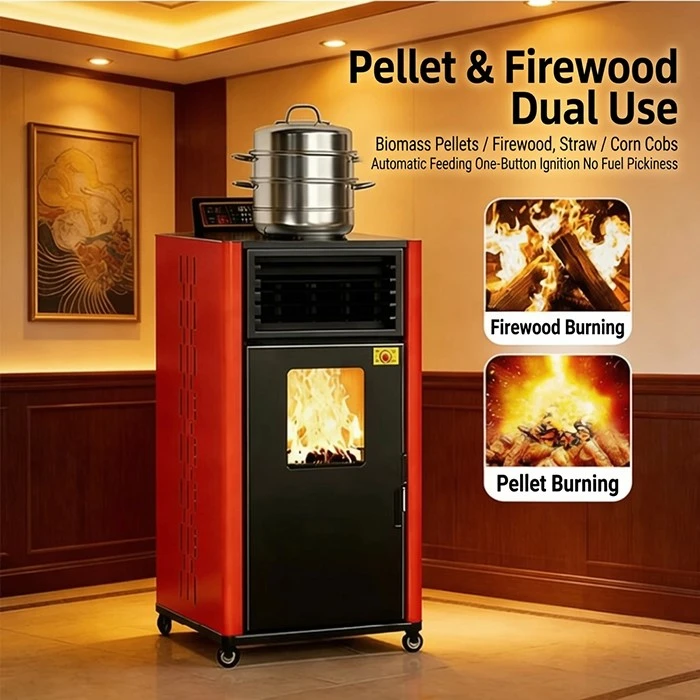
The pellet stove takes up little space, heats up quickly, is economical and practical, safe and comfortable, and can be controlled intelligently. It can be used in apartments or households. It is a relatively good real-fire fireplace. Its advantages are as follows:
1. Compact Footprint
Pellet fireplaces have a small footprint and are portable. Additionally, processing fuel into pellets reduces the required storage volume by more than fivefold, significantly saving space.
2. Economical and Practical
Pellet fireplaces are suitable for any home layout and require no structural modifications. The residual ash is a type of potassium fertilizer widely used in rural areas; it promotes plant growth and serves as an excellent garden fertilizer.
3. Safety
Pellet fireplaces remain cool to the touch on the outside while burning intensely within; this design minimizes the risk of accidental burns. Furthermore, the complete combustion of pellets ensures minimal creosote buildup in the flue, thereby reducing fire hazards.
Some models also feature automatic shut-off upon door opening, a design that does not deplete indoor oxygen, and automatic extinguishing systems triggered by high-temperature alerts.
4. Healthy and Comfortable
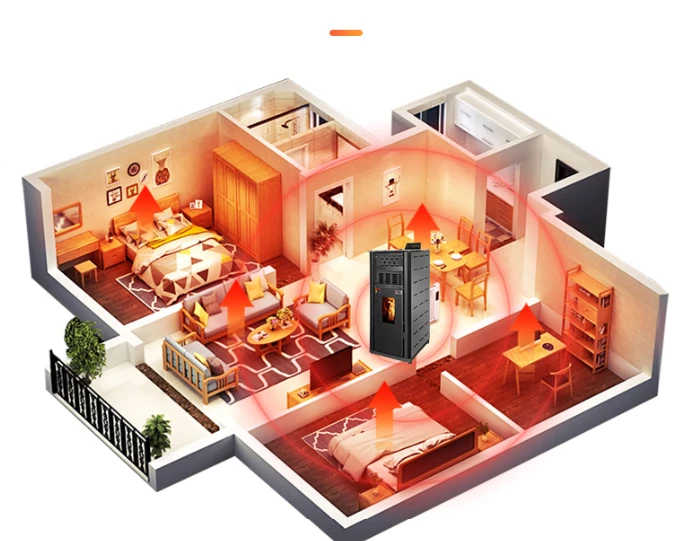
Using a combination of convection and thermal radiation, these fireplaces provide even heating. The convection of fresh air helps regulate and improve indoor air quality, offering a natural, comfortable warmth that does not dry out the air. Additionally, the thermal radiation promotes blood circulation and enhances neuromuscular activity, benefiting overall health.
5. Intelligent Control System
Pellet fireplaces feature automatic fuel feeding, electronic ignition, and automatic ash cleaning. An automatic cleaning cycle clears ash from the burn pot after each use; as long as the hopper is stocked with fuel, the system operates autonomously. The unit ignites and feeds fuel automatically-requiring no manual supervision-and allows for precise temperature control as well as scheduled ignition and shutdown times. A single load of fuel can provide continuous heating for up to 24 hours.
For more information, please contact Kewei Fireplaces!
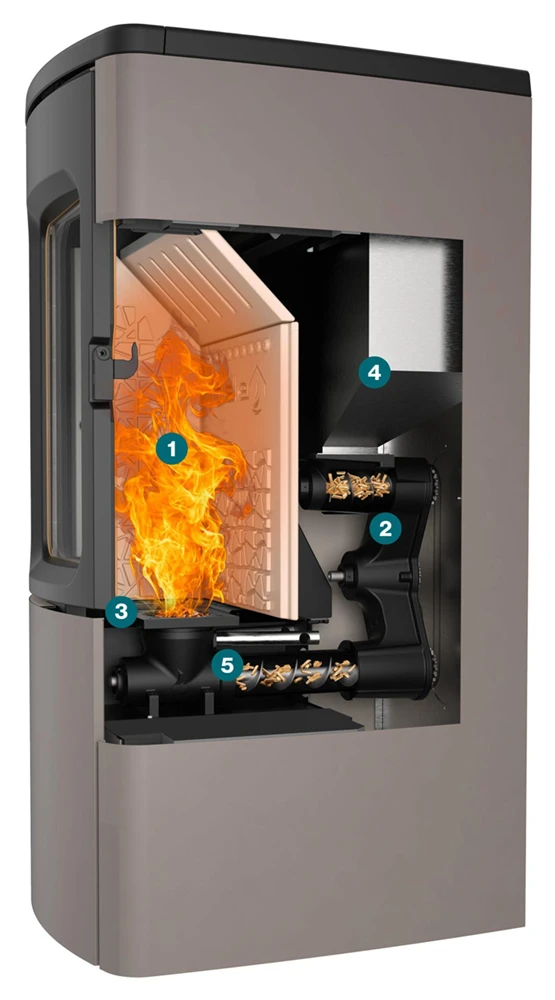
Working Principle
The pellet furnace primarily consists of a combustion chamber, a heating chamber, and an exhaust system. By controlling the fuel within the combustion chamber, granular materials are subjected to intense heat, thereby achieving the desired heating and processing. The working principle is as follows:
1. Preparation: The granular materials to be heated are placed into the heating chamber, and the heating temperature and duration are set.
2. Ignition and Fuel Supply: The ignition system in the combustion chamber initiates ignition and releases fuel, creating a combustion flame.
3. Fuel Combustion: The fuel mixes thoroughly with air inside the combustion chamber and burns, generating high-temperature combustion gases.
4. Hot Air Generation: The high-temperature combustion gases pass through the connecting passage between the combustion chamber and the heating chamber, delivering hot air to the heating chamber.
5. Heating of Granular Materials: The high-temperature hot air comes into full contact with the granular materials in the heating chamber, transferring heat to raise them to the required temperature.
6. Discharge and Circulation: The heated granular materials are discharged from the bottom of the heating chamber for further processing or reuse. Simultaneously, exhaust gases generated during combustion are vented through the exhaust system.
Are pellet-burning heaters effective?
Yes, they are highly effective. Pellet fuel generates significant heat and boasts high combustion efficiency, allowing it to rapidly warm indoor air. It also offers stable combustion and a long burn time, ensuring sustained heating. Furthermore, the combustion process produces minimal ash, resulting in lower environmental impact. Consequently, pellet-burning heaters deliver excellent heating performance.
#PelletHeaterEffectiveness #FullyAutomaticPelletHeaterManufacturing #BiomassPelletHeaterWholesale
Pellet heaters and air conditioners share similar basic control methods, both supporting operation via remote control or mobile app. However, pellet heaters require additional maintenance: fuel must be added periodically during use (once daily is recommended, and the process is simple), and the ash bin needs to be cleaned to prevent excessive ash accumulation. In contrast, air conditioners simply need to be plugged in to operate and require no additional maintenance.
Pellet heating stoves offer superior heating comfort. They deliver air at temperatures of 60–70°C with high velocity and long-range airflow, resulting in a warmer sensation for the human body.
Pellet heating stoves offer significant cost-efficiency advantages. Taking an 80-square-meter space as an example, the total daily cost (including electricity and pellet fuel) is approximately 10–20 yuan.